AI Analysis for Building & Structure Inspections
Review inspections roughly ten times faster. With Hammer Missions AI, an engineer can work through around 250 images an hour versus about 25 by hand — detecting defects, quantifying them, and querying the whole inspection in plain language.

Review 250 images an hour, not 25
A major bottleneck in modern inspection is the review process. Reviewing imagery by hand, an engineer gets through roughly 25 images an hour. With Hammer Missions AI surfacing and quantifying defects, that rises to around 250 an hour — about a tenfold improvement.
Weeks of review become days, senior staff spend their time on judgment rather than scrolling, and you can take on more projects with the same team while reducing project risk through sheer efficiency.
Three parts, one solution
Hammer Missions AI has three components that work on the same model:
AI Defect Detection — Spector AI
Spector AI automatically detects visible defects across roofs, facades, bridges, and interior decks — cracks, corrosion, spalling, and water ingress — so nothing significant is lost in a photo folder. It can learn from your annotations to highlight project-specific conditions.
AI Quantification — Hamlet AI
Hamlet AI turns detections into numbers: counts, areas, lengths, severity, and condition assessment. Quantities are measured on the model and carried through to the report, so a scope is built on figures rather than estimates.
ALICE — the AI agent for analysis
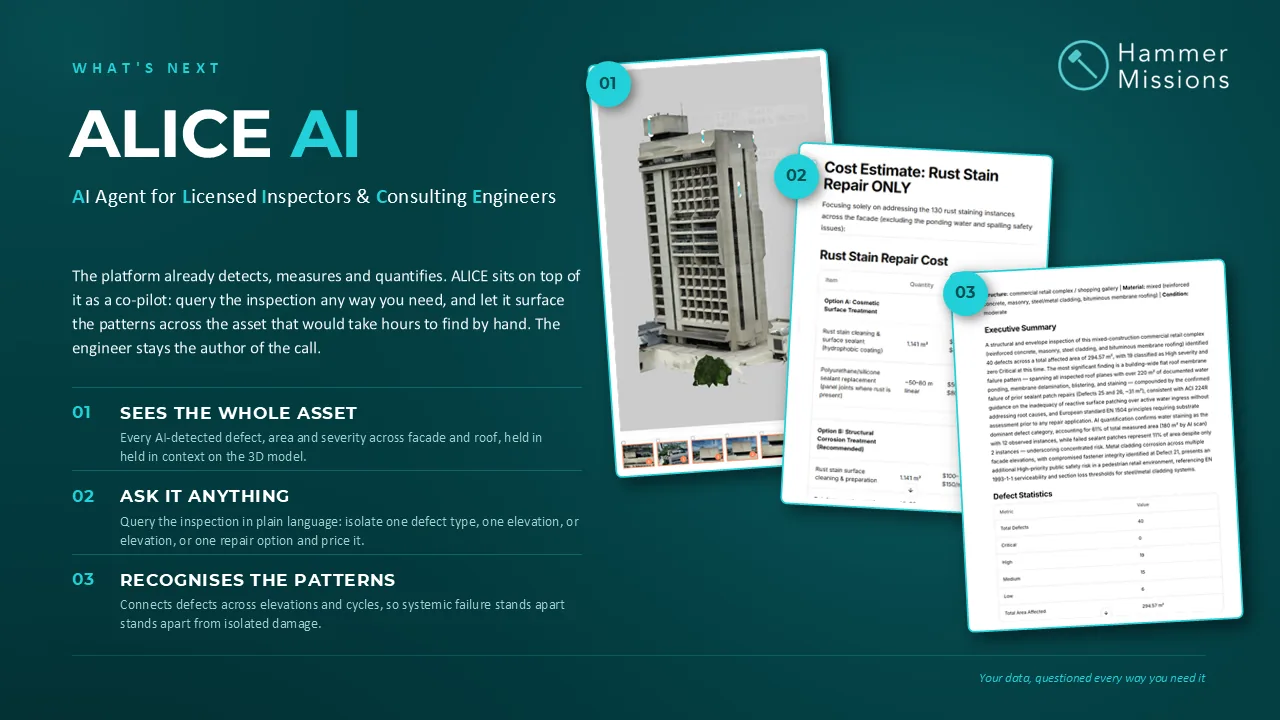
ALICE (AI Agent for Licensed Inspectors & Consulting Engineers) sits on top of the platform as a co-pilot and lets an engineer query a completed inspection in plain language. Every answer is tied to the model, so findings stay inspectable and the engineer stays the author of the call.
Detection finds it, quantification measures it, and ALICE lets you interrogate the whole result — one solution, one model, one record.
Meet ALICE
It holds the whole asset at once. Every AI-detected defect, measured area, and severity is unified across facade and roof in a single view, because deterioration does not respect report-section boundaries. A drainage problem on a roof plane and the staining running down the elevation below it are the same fault, and ALICE treats them that way.
Ask questions the way an engineer would say them out loud. Isolate a defect type, restrict to one elevation, filter above a severity threshold, or scope and price a repair option. Every response is tied to the model, so you can inspect the evidence behind it and remain the author of the decision.
It separates systemic failure from isolated damage. ALICE recognizes patterns across elevations and inspection cycles. Twelve spalls scattered around a building are a maintenance item; the same twelve clustered along one construction joint and growing between cycles are a structural investigation. ALICE tells those apart.
Example output. Ask ALICE to scope a rust-staining repair and it returns an executive summary of condition, defect statistics broken down by severity, and priced repair options — cosmetic surface treatment versus structural corrosion treatment — with a recommendation. Quantities carry through from measured defect areas, and every figure traces back to a located defect on the model. Nothing is retyped.


Works on drone and Lidar data
The same AI runs on drone imagery from exteriors and on XGRIDS PortalCam Lidar capture from interiors and parking structures, so your analysis is consistent whatever the capture method.
Frequently Asked Questions
Hammer Missions supports most DJI Enterprise drones for flight planning & AI analysis.
For 3D modeling & AI analysis, you can also use Skydio, Parrot or Autel drones.
You can find a complete list over here: https://www.hammermissions.com/supported-drones
Hear It from Our Customers

"Manually documenting and quantifying the facade deficiencies would've been nearly impossible without Hammer Missions. These tools, combined with engineering principles and careful review, have provided a baseline for saving and repurposing this landmark building"
- Clay Harman, Associate, Senior Engineer at RDH Building Science Inc.
Get Started